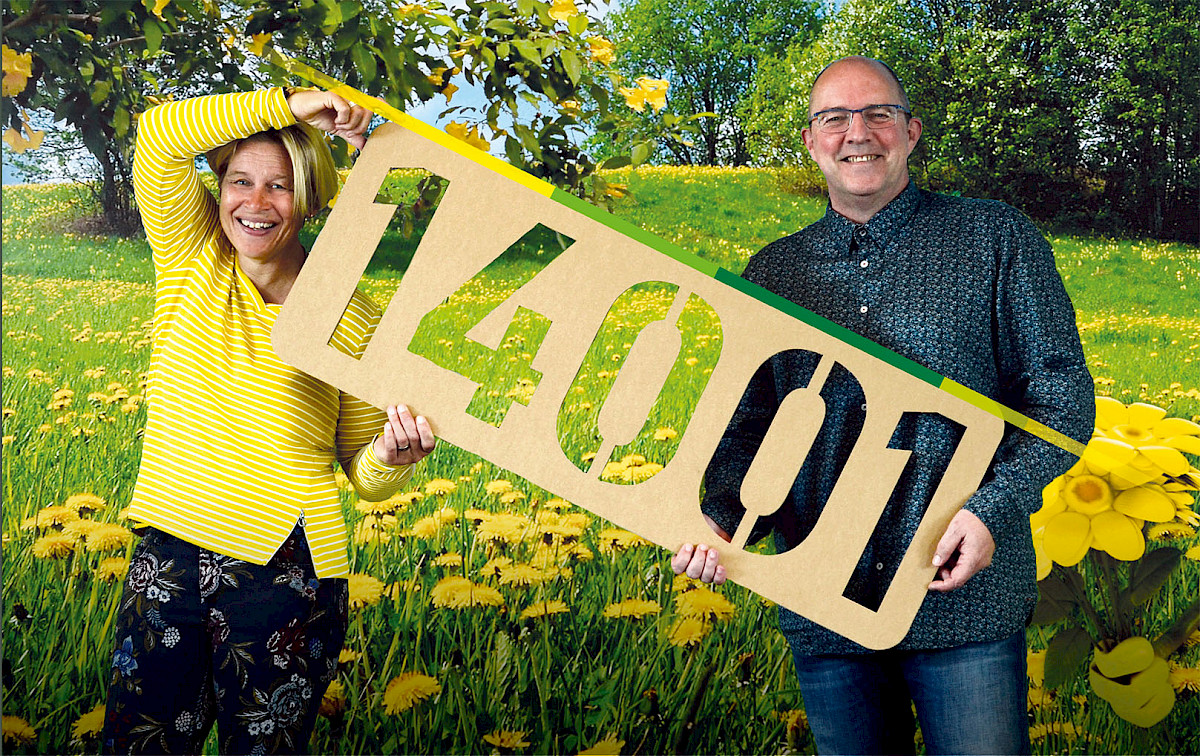
Of course, not everyone receives such an internationally recognised stamp. Melanie van Bracht is the owner of SHE* Mel safety and environmental support and has a wealth of experience with multinationals. She assists Holbox in the road to certification. "ISO 14001 is an initiative to reduce environmental damage by companies and shows that you are trying to minimise your footprint. Of course, certified companies comply with applicable laws and regulations, but it is primarily a management system that includes a stakeholder analysis and a risk analysis. A process that requires continuous development on the road to sustainability. Holbox has already made significant steps in the area of sustainability, ISO 14001 is the next."
Start at the beginning
According to Melanie, sustainability goes much further than people think. "It is more than complying with environmental legislation. Think about the environment in the chain, such as transporting the products to the customer or the design of the display, but also less environmentally related matters such as safety at work, work pressure and job satisfaction. The road to the label is therefore a road full of opportunities in which a company learns to think in new ways. And changing mindsets sometimes requires creativity and thinking out of the box. And that is precisely where Holbox's strength lies. To give shape to this management system, a team has been put together in which, apart from Melanie and the MT, Raimond Paulus is an important initiator. A first step in the process is to ensure a good baseline measurement, so that it becomes clear where the opportunities and challenges lie. All kinds of tools and analyses are available to achieve this, but they must be easy to read and workable. And that is exactly what Raimond is good at. "You can of course say that you are working in a sustainable way, but you have to be able to prove it. If there is no data and no insight into what is happening, no goals can be set. In my work as a Data Analyst, I extract variations from the work processes, so that everyone works in the right way. I do this by creating models, simplified images of reality. For the stakeholder analysis, I drew up a flow chart so that you can see all the process steps at a glance. If you know what steps there are and what they consist of, you can also look at what influences the environment and surroundings. That could be the use of raw materials, or electricity and waste flows. These are all things that we can look at critically and perhaps improve. A central place in the analysis is taken by the stakeholders themselves. These are the external factors that directly influence our right to exist. Our customers, for example, or suppliers and neighbours. Raimond also sees opportunities beyond the ISO certification. "This is a good time to think beyond ISO 14001. There are various ways in which efficiency can be improved. And that can also deliver commercial benefits."
More than just ISO
And that is music to Raimond Paulus' ears. "Melanie makes people and companies aware of the effect of their behaviour on the environment and surroundings. I study various budgets on a daily basis and prevent budget overruns. As a sustainable company, you also analyse the yield of your products and the efficiency of the business processes in relation to various environmental aspects. For me, the certificate is something that allows Holbox to distinguish itself in the market, something that the customer also demands. In my 20 years with Holbox, I have seen many changes with regard to sustainability. The inks, lacquers and glues used are now so much better for people and the environment, and the cardboard too consists of more than 90% - 95% recycled material. Holbox has always taken a leading role in innovation and sustainable thinking, and with this certificate we are cashing in on that role." The team's initial analyses did indeed reveal a number of Holbox's strengths. Melanie especially sees creativity as one of Holbox's great advantages. "Many companies I work with have a wait-and-see attitude. Holbox is different. You are used to thinking differently, and on top of that, the company has the whole process in its hands, which allows them to influence many factors. Their own design department allows them to immediately think about sustainable products such as grass paper, or displays that can be set up by the customer in order to reduce transport costs."
Check the controller
Once all the opportunities and challenges are clear, the work really begins. Because the whole process is, of course, monitored, Melanie explains. "After implementation, we are audited by audit companies. They, in turn, are also audited by the SCCM (Foundation for the Coordination of Certification of Management Systems for the Environment and Health and Safety at Work). But ultimately it's about the people on the work floor doing it themselves. A lot of things can be put down on paper, but that won't work if they are not supported on the work floor. Moreover, employees often already have very good and practical ideas for optimising a work process. It is a process of the entire chain, which does not stop at the factory alone. It may seem rather elaborate, but that is precisely where the power lies. And I am sure that Holbox will be able to pull the cart.